
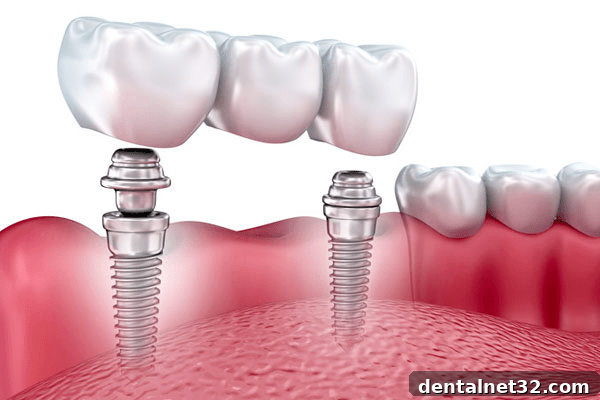
Losing two or more teeth in a row can significantly impact your confidence, your ability to eat comfortably, and your overall oral health. The gap left behind isn’t just a cosmetic issue; it can lead to a cascade of dental problems, including shifting teeth and jawbone deterioration. Fortunately, modern restorative dentistry offers several advanced solutions to bring back your smile’s function and beauty. While options like partial dentures exist, one of the most effective and permanent solutions is the implant-retained bridge.
This comprehensive guide will explore what an implant-retained bridge is, how it compares to other treatments like dentures, and why it stands out as a superior choice for replacing consecutive missing teeth. If you’re seeking a stable, long-lasting, and natural-looking solution, understanding the benefits of this innovative treatment is the first step toward reclaiming your smile.
Understanding the Core Problem: The Consequences of Missing Teeth
Before diving into the solution, it’s crucial to understand the problem. When you lose teeth, the consequences extend far beyond the visible gap. The roots of your natural teeth play a vital role in stimulating the jawbone, signaling to your body to maintain its density and strength. When that stimulation is lost, a process called bone resorption begins.
This gradual deterioration of the jawbone can lead to:
- Changes in Facial Structure: A shrinking jawbone can cause your cheeks to look sunken and your facial profile to change, often making you appear older.
- Shifting of Adjacent Teeth: The remaining teeth may begin to drift or tilt into the empty space, causing a misaligned bite, difficulty chewing, and potential TMJ (temporomandibular joint) issues.
- Difficulty Speaking and Eating: Missing teeth can make it challenging to pronounce certain words and limit your diet to softer foods, potentially affecting your nutrition.
- Decreased Confidence: A noticeable gap in your smile can make you hesitant to smile, laugh, and engage socially with confidence.
Restorative solutions aim to solve not just the cosmetic issue but also these underlying functional and health problems. This is where the distinction between different types of restorations becomes critical.
What Is an Implant-Retained Bridge? A Closer Look
An implant-retained bridge is a state-of-the-art dental prosthesis designed to replace three or more missing teeth in a row. Unlike a traditional bridge that relies on adjacent natural teeth for support, this solution is anchored directly to the jawbone using dental implants.
Here’s how it works:
- Dental Implants: Two or more small, biocompatible titanium posts are surgically placed into the jawbone at either end of the gap. These posts act as artificial tooth roots.
- Osseointegration: Over a period of a few months, the jawbone naturally fuses with the titanium implants in a process called osseointegration. This creates an incredibly strong and stable foundation.
- The Bridge: A custom-crafted bridge, consisting of a series of connected artificial teeth (called pontics), is then securely attached to the implants. The teeth on the ends of the bridge fit over the implants, while the ones in the middle float above the gum line, perfectly closing the gap.
The result is a fixed, non-removable restoration that looks, feels, and functions just like your natural teeth.
What Is a Partial Denture? A Traditional Alternative
A removable partial denture is another common option for replacing multiple missing teeth. This appliance typically consists of replacement teeth attached to a pink or gum-colored plastic base, sometimes connected by a metal framework. It stays in place by clasping onto the remaining natural teeth.
While dentures are a viable and often more affordable initial option, they are fundamentally different from implant-supported solutions. They are removable, rest on the soft gum tissue, and do not integrate with the jawbone.
Why an Implant-Retained Bridge Is the Superior Dental Solution
When comparing an implant-retained bridge to a removable partial denture, the advantages of the implant solution become clear. It addresses the core problems of tooth loss in a way that dentures simply cannot. Here are four key reasons why an implant-retained bridge is a better long-term investment in your oral health.
1. Restores Full Dental Functionality and Stability
The most significant advantage of an implant-retained bridge is its unparalleled stability. Because it is anchored directly to your jawbone, it becomes a permanent part of your mouth. This means you can eat, speak, and laugh with complete confidence.
With a fixed bridge, you no longer have to worry about:
- Slipping or Clicking: Dentures can sometimes shift while talking or eating, causing discomfort and embarrassment. An implant bridge is completely stationary.
- Dietary Restrictions: You can enjoy all your favorite foods, including crunchy apples, steak, and nuts, without fear of dislodging your restoration. The biting force is comparable to that of natural teeth.
- Messy Adhesives: There is no need for dental creams or adhesives to hold your teeth in place.
2. Promotes Long-Term Jawbone and Gum Health
This is perhaps the most critical health benefit. As mentioned earlier, tooth loss leads to jawbone deterioration. A partial denture, which rests on the gums, does nothing to stop this process; in fact, the pressure it exerts can sometimes accelerate bone loss over time.
Implant-retained bridges solve this problem at its root. The dental implants act just like natural tooth roots, providing the necessary stimulation to the jawbone. This signal tells your body to continue sending nutrients to the area, thereby preserving bone density and preventing facial collapse. By maintaining a healthy jawbone, you also support the health of your gum tissues and the stability of the entire oral structure.
3. Preserves the Integrity of Your Natural Teeth
Another powerful advantage of an implant-retained bridge lies in how it affects the surrounding teeth. A traditional dental bridge requires the dentist to grind down the healthy, adjacent teeth to fit them with crowns that will support the bridge. This permanently alters and weakens otherwise healthy tooth structures, making them more susceptible to decay and problems in the future.
An implant-retained bridge is a self-supporting unit. It does not rely on any of your natural teeth for support. This means your adjacent teeth remain untouched, whole, and healthy, promoting better long-term oral health across your entire mouth.
4. Delivers Superior Aesthetics and a Natural Feel
Modern restorative dentistry has made incredible advancements in materials. Implant-retained bridges are crafted from high-quality porcelain or zirconia that masterfully mimics the appearance of natural tooth enamel. They possess the same translucent and light-reflecting properties, making them virtually indistinguishable from your other teeth.
Beyond just looking good, they feel natural. There is no bulky plastic base covering the roof of your mouth or irritating your gums. The bridge is streamlined and fits seamlessly into your smile. By preventing bone loss, it also helps maintain the natural contours of your face and jawline, ensuring your facial aesthetics are not compromised over time.
Longevity and Care: An Investment for Decades
When considering dental treatments, long-term value is essential. With proper oral care and regular dental check-ups, an implant-retained bridge can provide a lifetime of natural dental function. The implants themselves are designed to be a permanent fixture in your jaw.
In comparison, dentures often need to be relined, adjusted, or completely replaced every five to ten years as the shape of your jaw and gums changes due to bone resorption. Over a lifetime, the cumulative cost and inconvenience of maintaining dentures can be substantial.
Caring for an implant-retained bridge is also straightforward—you simply brush and floss around it just as you would with your natural teeth. Specialized flossing tools can help you clean underneath the bridge to ensure your gums stay healthy.
With an implant-retained bridge, you can finally stop worrying about your missing teeth and start living your life to the fullest. Eat the foods you love, speak with clarity, and smile with renewed confidence.
If you’re ready to explore a permanent solution for your missing teeth, it’s time to learn more about our restorative dental treatments. Contact us today to discover how an implant-retained bridge can transform your smile and your health. You can also book an appointment easily through our 24/7 online scheduling system.