
A Comprehensive Guide to Dental Bone Grafting: Restoring Your Jaw for a Perfect Smile
A radiant, confident smile is built on a foundation of more than just sparkling white teeth. The health of your gums and, most critically, your jawbone, plays an indispensable role. The jawbone acts as the anchor for your teeth, securing them firmly in place. When a tooth is lost—whether due to advanced decay, injury, or severe periodontal (gum) disease—the underlying jawbone begins to deteriorate in a process called resorption. This natural but problematic response occurs because the bone no longer receives the stimulation it needs from the tooth’s root. Over time, this bone loss can lead to significant oral health complications and alter your facial structure.
This is where dental bone grafting becomes a crucial restorative procedure. It is a highly effective surgical technique designed to rebuild and regenerate lost bone tissue in the jaw. By doing so, it creates a solid and stable foundation necessary for future dental restorations, such as dental implants, bridges, or even well-fitting dentures. Understanding this procedure is the first step toward reclaiming the health, function, and aesthetics of your smile.
Why is a Dental Bone Graft Necessary? Understanding Jawbone Resorption
To appreciate the importance of bone grafting, it’s essential to understand what happens after tooth loss. The alveolar ridge, the part of the jawbone that encases the tooth sockets, requires constant stimulation from the forces of chewing and biting to maintain its density and volume. When a tooth is gone, that stimulation ceases. In response, the body begins to break down and reabsorb the bone tissue in that area, viewing it as no longer necessary.
This resorption can lead to a cascade of issues:
- Insufficient Support for Implants: Dental implants, the gold standard for tooth replacement, require a certain amount of healthy bone to be surgically placed and fuse with the jaw. Without adequate bone height and width, implant placement is impossible.
- Shifting of Adjacent Teeth: The gap left by a missing tooth encourages neighboring teeth to drift into the empty space, causing bite misalignment, crooked teeth, and potential TMJ (temporomandibular joint) problems.
- Changes in Facial Appearance: Significant bone loss in the jaw can lead to a sunken or collapsed facial appearance, making you look prematurely older. It affects the support for your lips and cheeks.
- Poor Denture Fit: For those who wear dentures, a resorbed alveolar ridge provides a less stable base, leading to loose, uncomfortable, and ill-fitting prosthetics that can cause sores and difficulty eating.
A dental bone graft directly addresses these problems by rebuilding the jawbone, halting the resorption process, and creating a viable site for lasting dental solutions.
Common Scenarios Requiring a Dental Bone Graft
A dentist or oral surgeon may recommend a bone graft in several distinct clinical situations. Each scenario is tailored to the patient’s specific needs and long-term treatment goals.
1. Socket Preservation After a Tooth Extraction
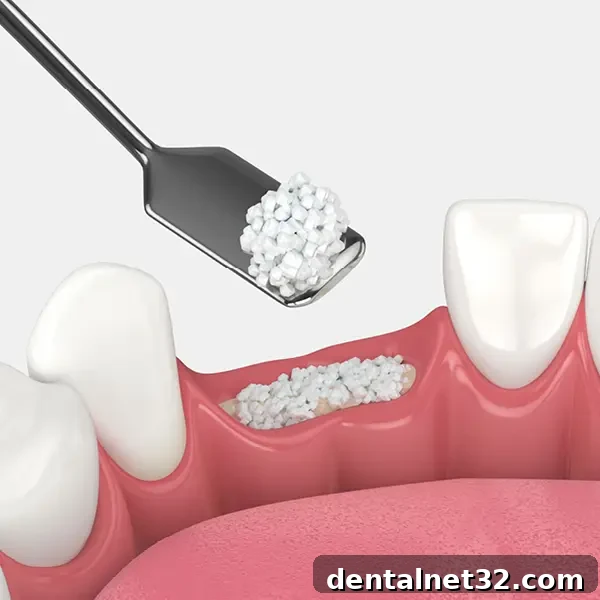
Perhaps the most common time for a bone graft is immediately following a tooth extraction. This procedure, known as socket preservation or ridge preservation, is a proactive measure. After the tooth is removed, the dentist fills the empty socket with bone grafting material. This material acts as a scaffold, preventing the socket walls from collapsing and encouraging the body to generate new, natural bone in its place. This simple step, often performed during the same appointment as the extraction, is crucial for preserving the bone’s height and width, making a future dental implant placement much more straightforward and successful.
2. Preparing the Jaw for Dental Implants
If a tooth has been missing for an extended period—months or even years—significant bone loss has likely already occurred. Before a dental implant can be placed, the deficient area must be rebuilt through a procedure called ridge augmentation. The oral surgeon will add bone graft material to increase the volume of the alveolar ridge. The site is then allowed to heal for several months, giving the graft time to integrate with the existing bone and create a solid, dense foundation capable of supporting an implant for a lifetime.
3. Addressing Bone Loss from Periodontal Disease
Advanced periodontal disease is a leading cause of tooth and bone loss. The chronic bacterial infection associated with this condition can destroy the bone that supports the teeth. In these cases, bone grafting can be used to repair the damage, regenerate lost bone around existing teeth to improve their stability, and restore the overall architecture of the jaw.
The Dental Bone Grafting Procedure: What to Expect
While it may sound complex, a dental bone grafting procedure is a routine and predictable surgery typically performed in a dental office. The process generally involves several key steps.
Step 1: Consultation and Planning
Your journey begins with a thorough examination, including digital X-rays or a 3D CBCT scan. This imaging allows the dentist to precisely measure the extent of bone loss and determine the exact amount and type of graft material needed. Your treatment options and goals will be discussed in detail.
Step 2: The Surgical Procedure
On the day of the surgery, the area is completely numbed with local anesthesia to ensure you are comfortable and pain-free. The dentist or surgeon then makes a small incision in the gum tissue to expose the underlying bone. The bone grafting material is carefully placed into the deficient area. In many cases, a special dissolvable membrane is placed over the graft. This membrane acts as a protective barrier, keeping the gum tissue from growing into the space and allowing the bone cells to regenerate undisturbed. Finally, the gum tissue is repositioned, and the incision is closed with small stitches (sutures).
Step 3: Healing and Integration
The healing phase is the most critical part of the process. Over the next four to six months (or longer, depending on the case), your body will work to replace the graft material with your own new, healthy bone. This process is called osseointegration. During this time, it is vital to follow your dentist’s post-operative instructions carefully. This includes maintaining excellent oral hygiene, eating a soft diet initially, and avoiding putting pressure on the surgical site.
Types of Bone Graft Materials
Dentists have several options for bone grafting material, and the choice depends on the specific needs of the patient and the size of the defect.
- Autografts: This involves using the patient’s own bone, typically harvested from another area of the mouth (like the chin or back of the jaw) or, for larger grafts, the hip. This is often considered the gold standard as it contains living bone cells and has no risk of rejection.
- Allografts: This is bone sourced from a human tissue bank. The bone is rigorously screened, sterilized, and processed to be completely safe and biocompatible for transplantation.
- Xenografts: This material is derived from an animal source, most commonly bovine (cow) bone. The bone is processed to remove all organic material, leaving only the mineral framework, which serves as an excellent scaffold for new bone growth.
- Alloplasts: These are synthetic, man-made materials, often composed of calcium phosphate or other biocompatible substances that mimic the structure of natural bone and encourage regeneration.
The Transformative Benefits of Dental Bone Grafting
Rebuilding your jawbone is an investment that pays dividends for your long-term oral and overall health. The benefits are numerous and profound.
The primary benefit is enabling you to receive dental implants, the most durable and natural-feeling solution for replacing missing teeth. An implant topped with a crown not only restores your ability to chew and speak properly but also looks and functions just like a real tooth. Furthermore, the implant itself continues to stimulate the jawbone, permanently halting the process of bone resorption.
Bone grafting also dramatically preserves your facial aesthetics. By restoring the jaw’s original dimensions, it provides support for the lips and cheeks, preventing the sunken look that often accompanies tooth loss and helping you maintain a more youthful profile.
For individuals who opt for dentures, a bone graft can significantly improve the fit, comfort, and stability of the prosthesis. A well-defined alveolar ridge prevents dentures from slipping, reducing irritation and making it easier to eat and talk with confidence. Ultimately, dental bone grafting is a foundational procedure that restores not just bone, but function, appearance, and quality of life.