
Your Comprehensive Guide to Understanding Common Dental Terminology
Have you ever sat in a dentist’s chair, listening to numbers and terms being called out, feeling like you’re trying to decipher a secret code? You’re not alone. The world of dentistry has its own unique language, and understanding it can empower you to take a more active role in your oral health. When you can communicate effectively with your dental team, you can ask better questions, understand your treatment options, and feel more confident in your care.
As dedicated dental providers, we believe that patient education is the cornerstone of excellent preventive care. That’s why we’ve created this comprehensive guide to “Decode Your Smile.” In this article, we will demystify the common terms, numbering systems, and anatomical references used in the dental profession. Let’s embark on this journey to transform dental jargon into everyday knowledge.
New Patient? Get a FREE Comprehensive Exam & X-Rays*
Whether it’s been six months or several years since your last dental visit, we’re here to help you achieve and maintain a healthy, beautiful smile. As a new patient, you are invited to receive a complete oral examination and necessary X-rays* at no cost. This allows our expert dentists to thoroughly assess your oral health and discuss your goals. LEARN MORE »
Understanding Your Teeth: Anterior vs. Posterior
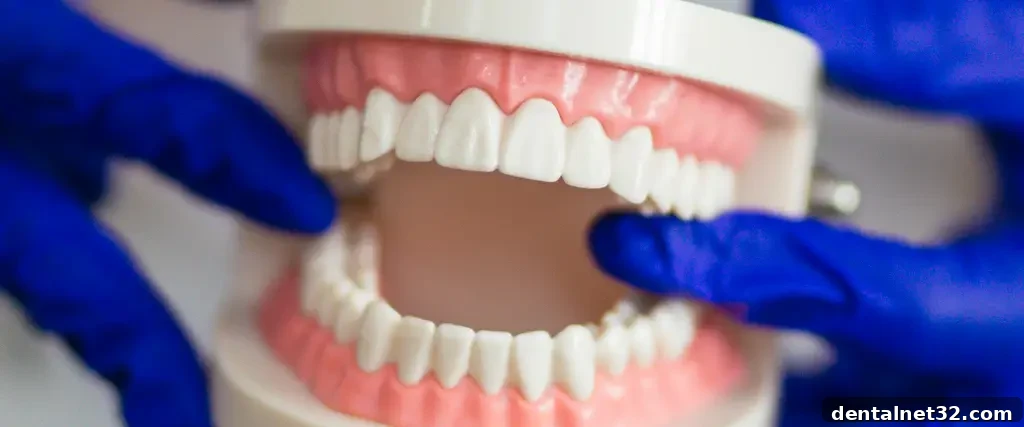
One of the most fundamental ways dentists classify teeth is by their location and function. The terms “anterior” and “posterior” are used to describe whether teeth are at the front or back of your mouth.
Anterior Teeth: The Stars of Your Smile
Anterior teeth are the ones located at the front of your mouth, the ones most visible when you smile. This group includes your incisors and canines. They are primarily designed for cutting and tearing food.
- Incisors: These are the four front teeth on both your upper and lower jaws. They have a thin, chisel-like edge, perfect for biting into foods like apples or sandwiches.
- Canines: Located at the corners of your smile, these are your sharpest teeth. Also known as “cuspids,” their pointed shape is ideal for tearing tougher foods. Due to their prominent position, anterior teeth play a significant role in aesthetics and speech.
Posterior Teeth: The Heavy Lifters
Posterior teeth are located in the back of your mouth and are essential for the primary work of chewing. This group includes your premolars and molars, which have broad, flat surfaces designed for grinding and crushing food into smaller, more digestible pieces.
- Premolars: Also called “bicuspids,” these are the transitional teeth located between your canines and molars. They have characteristics of both, helping to tear and grind food.
- Molars: These are your largest and strongest teeth. Their wide chewing surfaces with multiple cusps (points) make them highly effective at grinding down food before you swallow. This includes your wisdom teeth, or third molars, if they are present.
The Universal Tooth Numbering System: A Dental GPS
When you hear your dentist or hygienist calling out numbers during an exam, they are using a standardized system to identify each specific tooth. In the United States, the most common method is the Universal Numbering System. This system provides a unique number for each adult tooth, from 1 to 32, ensuring clear and precise communication among dental professionals.
The numbering starts from the upper right of your mouth and moves clockwise:
- Teeth #1-16: This covers your entire upper arch (maxilla). Tooth #1 is your upper-right third molar (wisdom tooth), and the count continues across to your upper-left third molar, which is tooth #16.
- Teeth #17-32: This covers your entire lower arch (mandible). The count drops down to your lower-left third molar, which is tooth #17, and continues across to your lower-right third molar, which is tooth #32.
This system is crucial for accurate charting, treatment planning, and communication with specialists or insurance companies. Knowing this system can help you follow along during your exam and better understand which tooth is being discussed.
The Foundation of Your Smile: Maxillary & Mandibular Arches
While these terms might sound complex, they simply refer to the upper and lower jaws that house your teeth. Understanding their distinct roles is key to appreciating the mechanics of your bite and overall oral function.
The Maxillary Arch: The Immovable Upper Jaw
The maxillary arch is your upper jaw. It holds all of the upper teeth (teeth #1-16) and is a fixed part of your skull. This immobility provides a stable, strong foundation against which the lower jaw functions. The maxillary arch does more than just hold teeth; it also forms the roof of your mouth, known as the hard palate. This structure is vital for both proper speech and the act of swallowing, as it separates your oral cavity from your nasal cavity.
The Mandibular Arch: The Dynamic Lower Jaw
In contrast, the mandibular arch is your lower jaw, which holds the lower set of teeth (teeth #17-32). The most significant feature of the mandible is its mobility. It is the only bone in the skull that can move, connected by the temporomandibular joint (TMJ). This sophisticated joint allows your mouth to open, close, and move from side to side. This movement is essential for chewing, enabling your lower teeth to grind against the upper teeth to break down food effectively. The mandibular arch is also fundamental to speaking and forming facial expressions.
Mapping Each Tooth: Understanding Tooth Surfaces
To be even more specific, dentists refer to the different surfaces of each tooth. This helps them pinpoint the exact location of a cavity, filling, or other issue.
- Occlusal: The chewing surface of the posterior teeth (premolars and molars).
- Incisal: The biting edge of the anterior teeth (incisors and canines).
- Buccal: The surface of a posterior tooth that faces the cheek.
- Facial/Labial: The surface of an anterior tooth that faces the lips.
- Lingual: The surface of any tooth that faces the tongue.
- Mesial: The surface of the tooth that is closest to the midline of your face.
- Distal: The surface of the tooth that is furthest from the midline of your face.
For example, your dentist might note a “cavity on the occlusal surface of tooth #30.” With your new knowledge, you would know this refers to a cavity on the chewing surface of your lower right first molar.
Take the Next Step in Your Oral Health Journey
At our practice, we believe that an informed patient is a healthy patient. By understanding the language of dentistry, you become a key partner in maintaining your oral health. This knowledge helps demystify the dental experience, reduces anxiety, and empowers you to make the best decisions for your smile.
Whether you need a routine check-up, have specific concerns, or simply want to learn more about achieving optimal dental health, our team is here to support you every step of the way. We are committed to working with you to ensure your smile remains bright and healthy for a lifetime. To schedule a consultation with our friendly and knowledgeable team, please call us today at (877) 880-1212 or easily book your visit through our online appointments page. We look forward to seeing you!