

The Ultimate Guide to Understanding and Treating a Cracked Tooth
Have you ever experienced a sudden, sharp jolt of pain in your mouth while enjoying a meal? One moment you’re chewing, and the next, a piercing pain stops you in your tracks. This common yet alarming sensation could be a sign of a cracked tooth. It’s a surprisingly frequent dental issue that can be difficult to diagnose but is crucial to treat promptly to avoid further complications. This comprehensive guide will explore the symptoms, causes, diagnosis, and treatment options for a cracked tooth, empowering you to protect your oral health.
What is a Cracked Tooth? The Hidden Culprit Behind Your Dental Pain
A cracked tooth, also known as a fractured tooth, refers to a crack or split in the tooth’s structure. These fractures can vary in depth and size, ranging from tiny, harmless craze lines on the enamel to deep cracks that extend into the root. The pain associated with a cracked tooth is often unique. When you bite down, you apply pressure that can cause the crack to open slightly. This movement may not hurt initially. However, when you release the bite, the pressure is removed, and the crack snaps shut. This sudden closing action irritates the sensitive inner pulp of the tooth, which contains nerves and blood vessels, resulting in that characteristic sharp, momentary pain.
If left untreated, this constant irritation of the pulp can lead to inflammation or infection. The tooth may become increasingly sensitive to temperature changes (hot and cold) and sweetness. Eventually, the pulp can become irreversibly damaged, leading to a severe, persistent toothache and necessitating more complex treatments like a root canal.
Recognizing the Warning Signs: Common Cracked Tooth Symptoms
Identifying a cracked tooth can be tricky because the symptoms can be inconsistent. You might not feel pain all the time, which can lead people to ignore the issue. However, being aware of the key signs can help you seek timely dental care. Look out for the following symptoms:
- Erratic Pain When Chewing: The most common symptom is pain that comes and goes, especially when you bite down on food. The pain may be more pronounced when you eat certain foods or bite in a specific way.
- Pain Upon Releasing Your Bite: As mentioned, a sharp pain when you stop biting is a classic indicator of a cracked tooth.
- Sensitivity to Temperature and Sweets: The crack can expose the underlying dentin and pulp to external stimuli. This can cause a painful reaction when you consume hot, cold, or sugary foods and drinks.
- Localized Gum Swelling: You may notice swelling in the gum area around the affected tooth. This can be a sign that the crack has allowed bacteria to cause an infection.
- No Visible Signs: Often, the crack is a hairline fracture that is invisible to the naked eye and may not even show up on initial dental X-rays, making a professional diagnosis essential.
Why Do Teeth Crack? Exploring the Common Causes
Our teeth are incredibly strong, but they are not indestructible. Various factors can contribute to a tooth cracking under pressure. Wesley Chapel dentist Dr. Diaa Ghabbour, who practices at Coast Dental Wesley Chapel, notes that a tooth may crack for several reasons. “Teeth grinding, clenching your teeth, even biting down on something hard such as nuts or ice can cause a tooth to fracture,” Dr. Ghabbour explains. The common culprits include:
- Bruxism (Teeth Grinding and Clenching): This habit places immense and prolonged stress on your teeth, leading to fractures over time.
- Chewing on Hard Objects: Biting down on ice, hard candy, unpopped popcorn kernels, or nuts can create a sudden, focused pressure that is strong enough to crack enamel.
- Large Dental Fillings: While fillings restore teeth, a particularly large one can weaken the natural tooth structure, making it more susceptible to cracking.
- Trauma or Injury: A blow to the mouth from a sports injury, a fall, or an accident can easily cause a tooth to crack. Dr. Ghabbour adds, “The patient may have injured his or her mouth in an accident, such as a baby’s head hitting the parent’s lower jaw.”
- Age: Teeth can naturally become more brittle with age, increasing the risk of cracks and fractures after years of wear and tear.
- Sudden Temperature Changes: Rapidly changing the temperature in your mouth, such as eating hot soup and immediately drinking ice water, can cause the tooth to expand and contract, potentially leading to tiny fractures.
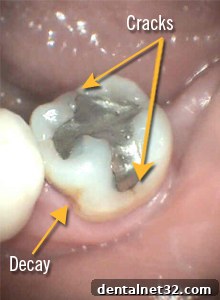
This image shows a tooth with two visible cracks and decay near the gumline, illustrating how multiple issues can affect a single tooth.
The Challenge of Diagnosis: How Dentists Find a Cracked Tooth
One of the biggest challenges with a cracked tooth is locating the fracture. As mentioned, these cracks can be microscopic and may not be visible on an X-ray. Your dentist will need to act as a detective, using several methods to pinpoint the source of your pain:
- Patient History: Your dentist will start by asking you detailed questions about your symptoms, such as when the pain occurs and what triggers it.
- Visual Examination: Using a magnifying loupe and a bright light, the dentist will carefully inspect the tooth for any visible lines or fractures.
- Dental Explorer: A sharp-pointed tool called an explorer can be used to gently feel the tooth surface for any cracks or catches.
- Bite Test: You may be asked to bite down on a small instrument or stick. If you feel a sharp pain upon releasing the bite, it helps confirm the diagnosis and locate the specific cusp that is fractured.
- Transillumination: By shining a special high-intensity fiber-optic light through the tooth, your dentist can often see a crack as a dark line that obstructs the light.
- Dental Dye: A special dye can be applied to the tooth, which will seep into any cracks and make them more visible.
Your Path to Relief: Cracked Tooth Treatment Options
The treatment for a cracked tooth depends entirely on the location, direction, and severity of the crack. The earlier a crack is detected, the better the chances of saving the tooth with a simpler, less invasive procedure. Your dentist will evaluate your specific situation to determine the best course of action.
Dental Bonding
For very small, superficial cracks, dental bonding can be an effective solution. In this procedure, your dentist applies a plastic composite resin to the tooth, filling the crack and restoring its shape. The resin is then hardened with a special light, bonding it to the tooth structure and sealing the fracture.
Dental Crowns
A dental crown is the most common treatment for a cracked tooth. A crown is a custom-made cap that fits over the entire tooth, down to the gum line. It acts like a helmet, holding the cracked pieces of the tooth together, protecting it from further damage, and allowing you to chew without pain. Getting a crown typically requires two visits.
Root Canal Therapy
If the crack has extended deep into the tooth and damaged the pulp, a root canal will be necessary to save the tooth. During this procedure, the dentist removes the damaged pulp, cleans and disinfects the inside of the tooth, and then fills and seals it. After a root canal, the tooth will almost always require a crown to protect its now-brittle structure.
Tooth Extraction
In the most severe cases, the tooth may not be salvageable. If the crack extends below the gum line or splits the tooth into two separate, mobile pieces, extraction is often the only option. After the tooth is removed, your dentist can discuss replacement options like a dental implant, bridge, or partial denture to restore your smile and function.
Prevention is Key: How to Protect Your Teeth from Cracking
While not all cracks are preventable, you can take several steps to significantly reduce your risk:
- Avoid Chewing Hard Foods: Be mindful of biting down on ice, hard candies, popcorn kernels, and other substances that can damage your teeth.
- Wear a Mouthguard: If you play contact sports, always wear a custom-fitted mouthguard to protect your teeth from trauma.
- Address Teeth Grinding: If you grind or clench your teeth, especially at night, talk to your dentist about a custom nightguard to absorb the pressure.
- Maintain Good Oral Hygiene: Regular brushing and flossing help prevent cavities. Large cavities and fillings weaken teeth, making them more prone to cracks.
Don’t Ignore the Pain: When to See Your Dentist
The most important takeaway is to never ignore dental pain or sensitivity. What might seem like a minor annoyance could be a sign of a serious problem. The sooner a cracked tooth is diagnosed, the more treatment options you will have, and the higher the likelihood of saving your natural tooth. If you experience any of the symptoms discussed, schedule an appointment with your dentist immediately for a thorough examination.
 About the Expert: Diaa Ghabbour, DMD, has been practicing dentistry since 2000. He provides comprehensive general dentistry services to patients aged 9 and up at Coast Dental Wesley Chapel. His services include dental implant restorations, extractions, and periodontal disease management. As a member of the American Dental Association, Florida Dental Association, and the Academy of General Dentistry, he is committed to providing high-quality care. You can find him at 5348 County Road 581, Wesley Chapel, Florida, 33544. For appointments, call (813) 973-1837.
Reviewed by: Diaa Ghabbour, DMD
Reviewed by: Cindy Roark, DMD