
Understanding the Stages of Gum Disease: A Comprehensive Guide
We all share a common goal for our dental visits: to walk in, hear the dentist praise our excellent oral health, receive a routine cleaning, and then confidently schedule our next appointment in six months. It’s the ideal scenario, a testament to our daily care.
However, it can be a jarring experience when the reality of your check-up doesn’t match this expectation. You might be diligent with your oral hygiene, brushing twice daily, flossing when you remember, and using mouthwash. So, receiving a diagnosis of periodontal disease can feel both surprising and disheartening. How could this happen when you thought you were doing everything right?
How Your Daily Lifestyle Impacts Your Gum Health
The truth is that periodontal disease often develops from subtle, cumulative lapses in our daily routines. These small choices can have a significant impact on your oral health. Perhaps your mornings have become so rushed that you occasionally skip brushing, or exhaustion at night makes it easy to forget. Maybe you’re using a toothbrush that’s well over three months old, with frayed bristles that are no longer effective at cleaning properly.
One of the most common culprits is inconsistent flossing. When you don’t floss daily, a sticky film of bacteria called plaque accumulates between your teeth and beneath the gum line. This plaque can attach to the tooth’s root surfaces, where it causes inflammation. According to Dr. Michael Quinn, a seasoned periodontist with over two decades of experience, “After only 48 hours, plaque can harden and calcify into tartar, a substance so hard it can only be removed with professional dental instruments.”
These seemingly minor inconsistencies in hygiene can rapidly escalate into major oral health problems. At a dental check-up, your dentist utilizes a combination of dental X-rays and a thorough oral examination to assess the health of your teeth and gums. This evaluation follows the classification system established by the American Academy of Periodontology (AAP). If left untreated, the initial inflammation caused by plaque can progress, causing the gums to pull away from the teeth. This separation creates small spaces called periodontal pockets, which become breeding grounds for harmful bacteria, leading to infection.
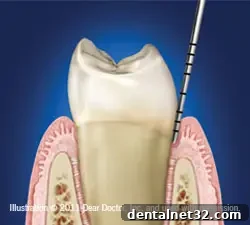
To diagnose the severity of the condition, clinicians use a small dental instrument called a probe to measure the depth of the space between your tooth and gum, known as a sulcus. As gum disease advances, these pockets become deeper, signaling a more severe infection that requires more extensive, costly, and time-consuming treatments. It’s a sobering fact that periodontal disease is the leading cause of adult tooth loss in the United States. Ignoring the signs allows the disease to destroy the bone and gum tissue that support your teeth, eventually leading to a point where teeth become loose and may need to be extracted.
A Healthy Mouth: The Benchmark for Oral Wellness
This illustration represents the ideal state of oral health. Key clinical findings for a healthy mouth include a sulcus or pocket depth of 0-3 millimeters, with no evidence of bone loss on X-rays. The gums are characteristically pink, firm, and do not bleed during brushing, flossing, or professional probing. There is no root exposure, and the teeth are stable. This level of health is maintained through consistent at-home care and regular professional cleanings.
Gingivitis: The Reversible Warning Sign
Gingivitis is the earliest stage of periodontal disease and, crucially, it is the only stage that is completely reversible. In a mouth with gingivitis, clinical findings may include pocket depths of up to 4 millimeters. The gums often appear red and swollen and may bleed easily during probing or routine brushing. You may notice inflammation, plaque, and some calculus (tartar) buildup. However, at this stage, there is no bone loss or root exposure. Treatment typically involves a professional dental cleaning and a renewed commitment to meticulous at-home care. In cases with significant buildup, a more intensive cleaning called a debridement may be necessary to remove all irritants, followed by a second cleaning to restore periodontal health.
Slight Chronic Periodontitis: The Point of Irreversible Damage
Once gum disease progresses from gingivitis to periodontitis, the damage becomes irreversible. At this stage, the focus of treatment shifts from reversal to management to prevent further progression. Clinical findings include pocket depths of 4-6 millimeters. Bleeding on probing is common, and pus may be present, indicating an active infection. Plaque and calculus are typically visible. X-rays will reveal early signs of bone loss, and you may notice slight root exposure as gums begin to recede. The standard treatment for this stage is a deep cleaning procedure known as Scaling and Root Planing, often supplemented with adjunctive therapies like dental lasers or localized antibiotics. Patients will also require more frequent maintenance cleanings to manage the disease.
Moderate Chronic Periodontitis: A Worsening Condition
As the disease progresses to the moderate stage, the signs and symptoms become more pronounced. Clinical findings typically include pocket depths of 5-6 millimeters, with red and swollen gums. Bleeding, pus, and significant plaque and calculus buildup are common. Moderate root exposure and noticeable bone loss are evident on X-rays. At this stage, teeth may begin to feel slightly loose due to the loss of supporting bone and tissue. The treatment plan still centers around Scaling and Root Planing and adjunctive therapies, but the prognosis for some teeth may be guarded. A referral to a periodontist, a specialist in gum diseases, may be recommended to manage the condition more effectively.
Advanced Periodontitis: The Final and Most Severe Stage
This is the most critical stage of periodontal disease, where the risk of tooth loss is highest. Clinical findings show deep pockets of 6 millimeters or more. The gums are often severely inflamed, and bleeding and pus are frequently present. Severe root exposure is common, as the gums have receded significantly. X-rays reveal severe bone loss, which can lead to teeth becoming very loose, shifting position, or even falling out. While Scaling and Root Planing is still a necessary first step, surgical intervention by a periodontist is often required to save the remaining teeth. Due to the advanced nature of the bone loss, some teeth may be deemed non-restorable and will require extraction.
 A Message from the Expert
Michael Quinn, DMD, has been a dedicated dental professional since 1987. As a Board Certified Periodontist, he specializes in treating gum disease and related conditions for patients of all ages. His expertise includes a wide range of services, such as bone grafting, crown lengthening, dental implants, periodontal disease management, and soft tissue grafts. Dr. Quinn provides his specialized care at several Coast Dental offices across Georgia, including locations in Atlanta, Marietta, Fayetteville, Lawrenceville, and Stone Mountain, helping patients restore and maintain their oral health.
Reviewed by: Michael Quinn, DMD
Reviewed by: Charbel Klaib, DMD
Reviewed by: Cindy Roark, DMD