
A Complete Guide to the Names and Functions of Your Teeth
Have you ever stopped to think about the intricate and specialized tools you have inside your mouth? Your teeth are much more than just a means to a beautiful smile; they are a complex system of highly specialized structures, each with a unique name, shape, and purpose. Understanding the different types of teeth and their specific roles is the first step toward appreciating their importance and maintaining excellent oral health. This comprehensive guide will take you on a journey through your dental anatomy, exploring each tooth’s function and why this knowledge is vital for your overall well-being.
Your Dental Blueprint: An Overview of Human Teeth
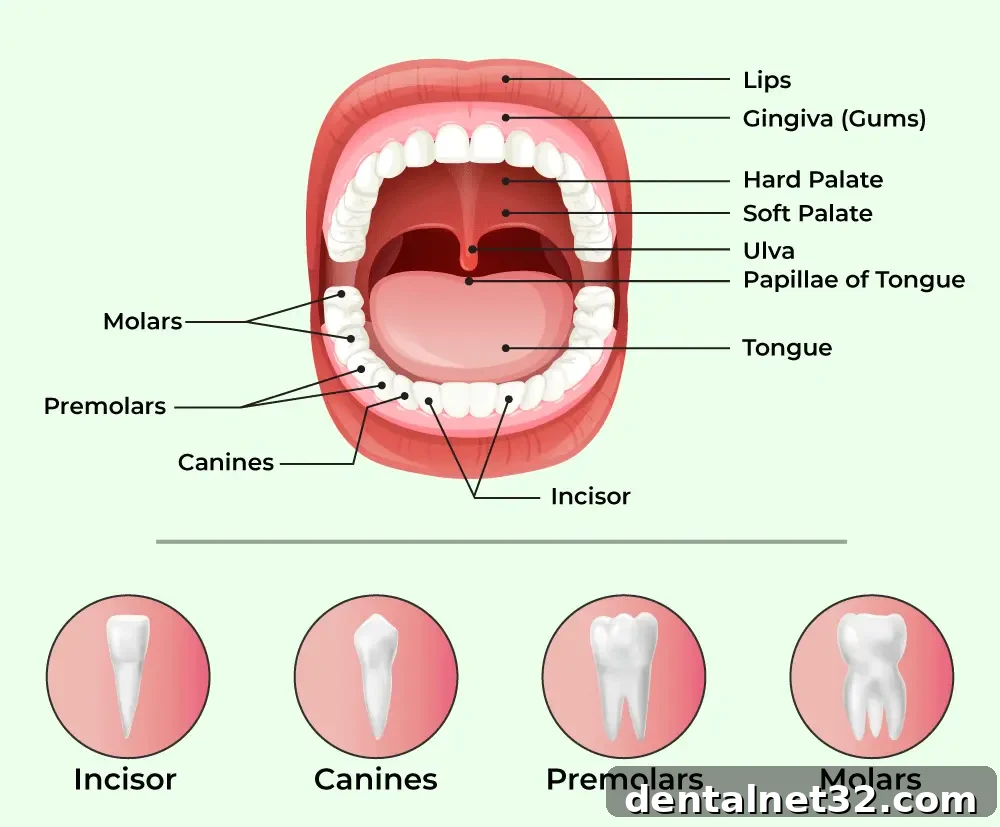
A complete set of adult teeth consists of 32 permanent teeth, meticulously arranged in the upper (maxillary) and lower (mandibular) arches. This is a significant increase from the 20 primary (or baby) teeth that serve us during childhood. Each of these 32 teeth falls into one of four distinct categories, classified by their shape, location, and function in the process of mastication (chewing). These categories are incisors, canines, premolars, and molars. Let’s explore the unique characteristics and critical responsibilities of each group.
The Four Primary Types of Teeth Explained
From the very front of your smile to the far back of your jaw, each tooth type is strategically positioned to work in harmony. Together, they form an efficient assembly line for breaking down food, aiding in speech, and supporting your facial structure.
1. Incisors: The Cutting Edge of Your Smile
Location: At the very front of your mouth.
Quantity: Eight in total (four on the top, four on the bottom).
The incisors are the stars of your smile—the first teeth people see. Their name is derived from the Latin word ‘incidere,’ which means ‘to cut.’ True to their name, these teeth have a thin, flat, chisel-like edge designed for slicing and cutting food into manageable pieces. You have two central incisors at the absolute front and two lateral incisors flanking them on each jaw. Beyond their primary role in taking the first bite of an apple or a sandwich, incisors also play a crucial part in phonetics—helping you pronounce words clearly—and they provide essential support for your lips, contributing to your facial aesthetics.
2. Canines (Cuspids): The Cornerstones of the Dental Arch
Location: Positioned at the ‘corners’ of your dental arches, next to the lateral incisors.
Quantity: Four in total (two on the top, two on the bottom).
Canine teeth, also known as cuspids, are easily identifiable by their sharp, pointed surface. They are the longest teeth in the human mouth, with a single, prominent cusp designed for gripping and tearing food. Think about eating tougher foods like meat or fibrous vegetables; your canines are the teeth that do the heavy lifting in this initial tearing process. Because of their length and strong roots, canines are incredibly stable and act as the “cornerstones” of your mouth. They help guide your jaw into the correct biting position and play a vital role in the alignment of your other teeth, absorbing significant pressure when you chew.
3. Premolars (Bicuspids): The Transitional Team
Location: Situated between the canines and the molars.
Quantity: Eight in total (four on the top, four on the bottom).
Moving further back in the mouth, you’ll find the premolars, also known as bicuspids. The term ‘bicuspid’ refers to the fact that these teeth typically have two cusps (points) on their chewing surface. Premolars are a hybrid of sorts, sharing characteristics with both the canines in front of them and the molars behind them. Their primary function is to crush and grind food, breaking it down into smaller particles that are easier to swallow. They act as a crucial transition, moving food from the front teeth towards the back molars for the final stage of chewing. The first and second premolars on each side work together to ensure food is thoroughly processed before it reaches the powerful molars.
4. Molars: The Grinding Powerhouses
Location: At the very back of your mouth.
Quantity: Typically twelve in total (six on top, six on the bottom), including wisdom teeth.
The molars are the largest and strongest teeth in your mouth. Their name comes from the Latin word ‘molaris,’ meaning ‘millstone,’ which perfectly describes their function. With their broad, flat surfaces and multiple cusps (typically four to five), molars are built for the intense work of grinding, crushing, and chewing food into a fine paste, making it safe to swallow and easy to digest. On each side of your jaw, you have a first molar, a second molar, and a third molar. The first molars are often the first permanent teeth to erupt, usually around age six, and are essential for maintaining the shape of the lower jaw.
A Special Note on Third Molars (Wisdom Teeth)
The third molars are more commonly known as wisdom teeth. They are the last teeth to erupt, typically emerging between the ages of 17 and 25—a time historically referred to as the “age of wisdom.” For our ancestors, who had a coarser diet, these extra molars were necessary. However, with modern diets and smaller jaws, wisdom teeth often cause more problems than they solve. Common issues include:
- Impaction: When a wisdom tooth doesn’t have enough room to erupt properly, it can become trapped (impacted) in the jawbone or gums, often growing at an angle.
- Crowding: An erupting wisdom tooth can push against adjacent teeth, causing misalignment, pain, and bite problems.
- Infection and Decay: Because they are so far back in the mouth, wisdom teeth are difficult to clean, making them highly susceptible to decay and gum infections (pericoronitis).
Due to these potential complications, dentists often recommend the proactive removal of wisdom teeth to prevent future dental health issues.
Why Understanding Your Dental Anatomy is Crucial for Oral Health
Knowing the names and functions of your teeth is more than just a fun fact; it is fundamental to practicing effective oral hygiene. This knowledge empowers you to take better care of your smile. When you understand the unique purpose of each tooth, you can tailor your cleaning routine to address its specific needs.
For example, recognizing that the grooved, complex surfaces of your molars are prime locations for food particles and bacteria to hide can motivate you to spend extra time brushing them thoroughly. Understanding that the incisors are thin and primarily for cutting helps you appreciate why using them to open packages or bite non-food items can easily lead to chips and fractures. This awareness transforms your daily oral care from a routine chore into a targeted, preventative health practice. It also enables you to have more informed and productive conversations with your dental care provider about your treatment options and health goals.
Partner with Coast Dental for a Lifetime of Healthy Smiles
At Coast Dental, we are passionate about patient education because we believe an informed patient is an empowered one. By helping you understand the intricate details of your own oral anatomy, we equip you with the tools to maintain a healthy, vibrant, and fully functional smile for a lifetime. Our dedicated team of dental professionals is committed to providing personalized and comprehensive care that goes beyond just treating problems—we aim to prevent them.
Whether you need a routine check-up and cleaning, have specific concerns about a tooth, or simply want to learn more about optimizing your oral hygiene routine, our team is here to guide and support you. Your smile is a critical part of your health and confidence, and every single tooth plays a vital role in its success.
Protect your dental health by understanding its complexity and partnering with a team that puts your well-being first. For more information or to schedule an appointment with one of our experienced dental professionals, please contact Coast Dental today at (877) 880-1212. Let’s work together to ensure your smile remains bright and healthy for years to come.