
How Does Invisalign Work? Your Ultimate Guide to Clear Aligners
If you’re considering orthodontic treatment to achieve a straighter, healthier smile, you’ve likely come across various options, from traditional metal braces to the increasingly popular Invisalign clear aligner system. More adults and teens are choosing Invisalign for its discreet and convenient approach to straightening teeth. But a common question remains: how exactly does a series of clear plastic trays move teeth into perfect alignment? Understanding the process is key to deciding if it’s the right choice for you.
As experienced providers of Invisalign, we want to demystify the process for you. In this comprehensive guide, we’ll explore everything you need to know about how Invisalign works. We will cover its history, the types of dental issues it can correct, the science behind the treatment, and what to expect during your step-by-step journey to a new smile.
A Brief History of Invisalign
The concept of a clear aligner system was brought to life in 1997 by two Stanford University students, Zia Chishti and Kelsey Wirth. They envisioned a method of straightening teeth that would be far less conspicuous than the metal brackets and wires that had dominated orthodontics for decades. Their idea was to leverage advanced 3D computer imaging to create a series of removable, clear plastic aligners. This innovation was specifically targeted toward adults seeking an effective orthodontic solution without the aesthetic impact of traditional braces. The launch of Invisalign marked a revolutionary shift in the field, offering a new level of discretion and flexibility.
What is Invisalign?
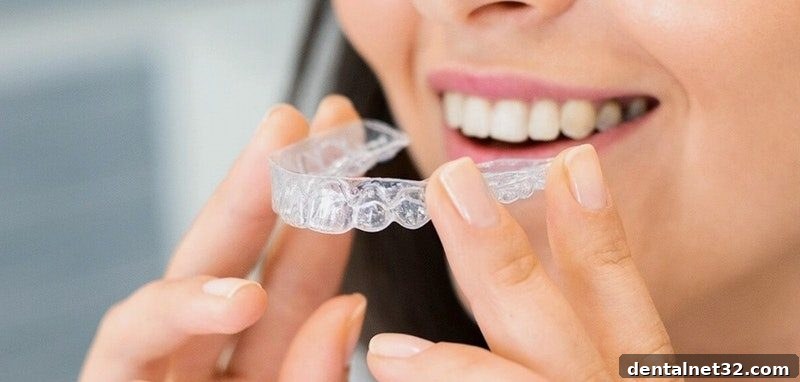
Invisalign is a modern orthodontic treatment that uses a series of custom-made, virtually invisible aligners to gradually and gently shift your teeth into their correct positions. These aligners are made from a patented, flexible plastic called SmartTrack® material, which is BPA-free and designed for comfort and precision. Unlike traditional braces, which are bonded to your teeth, Invisalign aligners are completely removable. You take them out to eat, drink, brush, and floss. For the treatment to be effective and stay on schedule, you must wear the aligners for 20 to 22 hours per day, progressing to the next set in your series approximately every one to two weeks, as directed by your dentist.
What Dental Issues Can Invisalign Fix?
Invisalign is a versatile treatment capable of correcting a wide range of mild to moderate dental alignment issues. While it may not be suitable for extremely complex cases that require surgical intervention, it effectively addresses many of the same problems as traditional braces. A consultation with your dental professional is the best way to determine if Invisalign can achieve your specific goals. The benefits of using clear aligners can be life-changing for the right candidate.
Common Issues Invisalign Can Correct:
- Overcrowded Teeth: This occurs when there isn’t enough space in the jaw for all teeth to fit naturally, causing them to bunch up, overlap, or twist. Invisalign gradually creates space and guides teeth into proper alignment.
- Overbite: An overbite is when the upper front teeth significantly overlap the lower front teeth. A severe overbite can lead to jaw pain, excessive wear on the lower teeth, and gum issues.
- Underbite: The opposite of an overbite, an underbite occurs when the lower teeth protrude past the upper teeth when the mouth is closed. This can interfere with chewing and speaking.
- Crossbite: A crossbite happens when some upper teeth sit inside the lower teeth rather than on the outside. If left untreated, it can cause uneven tooth wear and gum problems.
- Gapped Teeth: This issue involves extra spaces between two or more teeth. Gaps can be a cosmetic concern and may also leave gums more susceptible to disease.
- Open Bite: An open bite is when the upper and lower teeth do not make contact when the mouth is closed, creating a gap. This can cause significant chewing difficulties.
The Science of a Straighter Smile: How Invisalign Moves Teeth
The magic of Invisalign lies in its ability to apply a gentle yet consistent and controlled force to your teeth. The process begins with a precise 3D digital scan of your mouth. This data is used to create a highly accurate treatment plan that maps out the exact movement of each tooth from its current position to its final destination. Each aligner in your series is engineered to be slightly different from the last. When you wear an aligner, it applies targeted pressure to specific teeth, encouraging them to move into the position dictated by that stage of your plan. As you switch to the next aligner in the series, a new set of targeted pressures continues the gradual shifting process. This meticulously planned sequence ensures that only certain teeth move at a time, making the process efficient and predictable. Some cases may also require small, tooth-colored attachments to be bonded to certain teeth to give the aligners extra grip for more complex movements.
Your Invisalign Journey: A Step-by-Step Process
Embarking on your Invisalign journey is an exciting process. Understanding each step can help you feel confident and prepared as you work toward your new smile. Here’s what you can typically expect.
Step 1: Your Initial Invisalign Consultation
The first step is a consultation with your dentist or orthodontist to determine if Invisalign is the right fit for you. During this visit, your dental professional will perform a thorough examination of your teeth and jaw, take X-rays, and discuss your smile goals. This is also the perfect time to ask questions about treatment duration, cost, and insurance coverage. Your commitment to wearing the aligners for 20-22 hours daily is crucial for success, and your dentist will want to ensure you’re ready for that responsibility.
Step 2: Creating Your Custom Treatment Plan
Once you decide to move forward, your dentist will take precise 3D digital scans of your teeth—no more messy, uncomfortable putty impressions! These scans are sent to Invisalign, where technicians, following your dentist’s detailed instructions, create a customized 3D treatment plan. This digital plan, often called a ClinCheck® simulation, maps out the step-by-step transformation of your smile. One of the most exciting parts of this stage is that your dentist can show you a virtual representation of how your teeth will move and what your final results will look like before you even begin.
Step 3: Wearing Your Custom Aligners
About a month after your plan is finalized, your custom-made aligners will arrive at your dentist’s office. You’ll be called in for a fitting, where your dentist will ensure the first set fits perfectly and will explain all the instructions for wearing and caring for them. You will wear each set of aligners for one to two weeks before graduating to the next set in the series. As you progress, you’ll literally be able to see your teeth gradually moving into their new, straighter positions. Remember to only remove them for eating, drinking anything other than water, and your oral hygiene routine.
Step 4: The Refinement Phase
As you near the end of your initial series of aligners, your dentist will evaluate your progress. Sometimes, a few stubborn teeth may need a little extra persuasion to get into the perfect position. In these cases, your dentist may recommend a “refinement.” This involves taking new scans and ordering a few additional aligners to fine-tune your smile. This is a common and normal part of the process, designed to ensure you get the best possible results.
Step 5: Maintaining Your Beautiful New Smile with Retainers
Congratulations, you’ve completed your treatment! To protect your investment and keep your smile looking great for a lifetime, you will need to wear a retainer. Teeth have a natural tendency to shift back to their original positions over time. Retainers hold them in place while the bone and tissue in your jaw solidify around their new alignment. Invisalign offers Vivera® retainers, which are made from a thicker, more durable material. You will likely need to wear your retainer full-time for a few months, after which you’ll transition to wearing it only at night.
Contact Us for an Invisalign Consultation in Cary or Holly Springs
If you are considering straightening your teeth and want to learn more about the Invisalign process, our professional and knowledgeable dental team is here to help. At Sninski & Schmitt Family Dentistry, we will perform a comprehensive evaluation, discuss your goals, and help you determine if you are a good candidate for Invisalign treatment. We are committed to providing you with all the information you need to make an informed decision for your oral health and confidence. Call us today to schedule your consultation.
Contact our Holly Springs dentist office at (919) 600-6262 or our Cary, NC dentist office at (919) 467-2203. You can also fill out our online contact form to schedule an appointment and take the first step toward the smile you’ve always wanted.